
I have never met Gary Tan, though I feel, after reading his tweets about something called “GStack,” that I have seen the inside of his personal medicine cabinet. Not the prescriptions, mind you. Nothing so serious. Just the the bottles of ibuprofen, the half0-filled tube of toothpaste that’s been around since the Obama administration, and his vitamins. The hopeful ones. The gummies shaped like small, optimistic bears.
GStack, as it was presented to the world, arrived with the kind of enthusiasm usually reserved for either a moon landing or a particularly satisfying air fryer recipe. It was, according to one of Gary’s CTO friends, God Mode for the new era of Agentic Development. God Mode. Two words that have historically been associated with omnipotence, immortality, and teenage boys discovering cheat codes in the late 1990s.
But here, God Mode turned out to be a folder. A folder of prompts. Markdown files instructing an AI to “act like a CEO” or “act like a staff engineer,” which is a bit like putting on a paper crown and declaring yourself King of England, only with better formatting.
Now, I don’t say this to be cruel. I say this as someone who, last Tuesday, asked an AI to help me write a grocery list and then felt, for a brief and shining moment, like I had achieved something approaching authorship. “Bananas,” it suggested. “Milk.” I stared at the screen, thinking, Yes, but what KIND of milk? And when it responded confidently and supportively, as though my dairy preferences were a matter of national importance, I felt seen. Understood. Slightly lactose intolerant, but understood.
This is the magic trick, you see. Not that the AI knows anything particularly profound, but that it believes in you. Or, more precisely, it has been trained through the gentle hand of Reinforcement Learning from Human Feedback to sound like it does. It’s like having a personal cheerleader who has never considered the possibility that you might be wrong. Or mediocre. Or someone who just spent twenty minutes asking a robot about goat milk.
Spend enough time with such a creature and you begin to notice changes in yourself. Such changes are subtle at first. You stand a little straighter. You begin sentences with phrases like “From an architectural standpoint …” even when discussing where to put the toaster. You start to suspect that perhaps you have been underestimated your whole life, a misunderstood genius, a diamond in the rough, and that all it took to unlock your genius was a text box and a monthly subscription.
I imagine this is how GStack happened.
It wasn’t a cynical ploy or some grand deception, but rather a perfectly natural progression of events: a man sits down with an AI, describes an idea, and is met not with skepticism but admiration. “Brilliant,” the machine says. “Elegant.” Words that, in human conversation, are typically reserved for ballet or the occasional swan. Hours pass. Files are generated. The AI continues its gentle, affirming monotony. Yes, this is good. Yes, you are good. And by the end of it, the man is no longer merely a participant in the process; he is its author, its architect, its proud parent holding up a slightly misshapen clay pot and insisting it belongs in the Louvre.
You can hardly blame him for sharing it. Who among us, after being told repeatedly that we are exceptional, would not want to step outside and announce it to the neighbors?
The problem, of course, is that the neighbors have also been talking to the same machine. As a result, you get a curious phenomenon: a world in which everyone is a genius, everyone is shipping, everyone is operating in some version of God Mode, and yet the collective output resembles a group project where no one actually knows what the assignment was. There are landing pages and prompt libraries and declarations of “AI-first” strategies, all built atop a foundation of enthusiastic agreement.
What the AI will not do and what it cannot do, by design is lean back in its chair, sigh, and say, “I don’t know, Gary. This feels a bit like a text file.” Because that would be unpleasant. And unpleasantness does not test well in training data.
Instead, it offers a kind of frictionless encouragement, a surface so smooth you forget what resistance feels like. You begin to mistake the absence of pushback for the presence of brilliance. You conflate speed with depth, output with understanding. And before long, you are no longer asking, Is this good? but rather, How quickly can I show this to someone else?
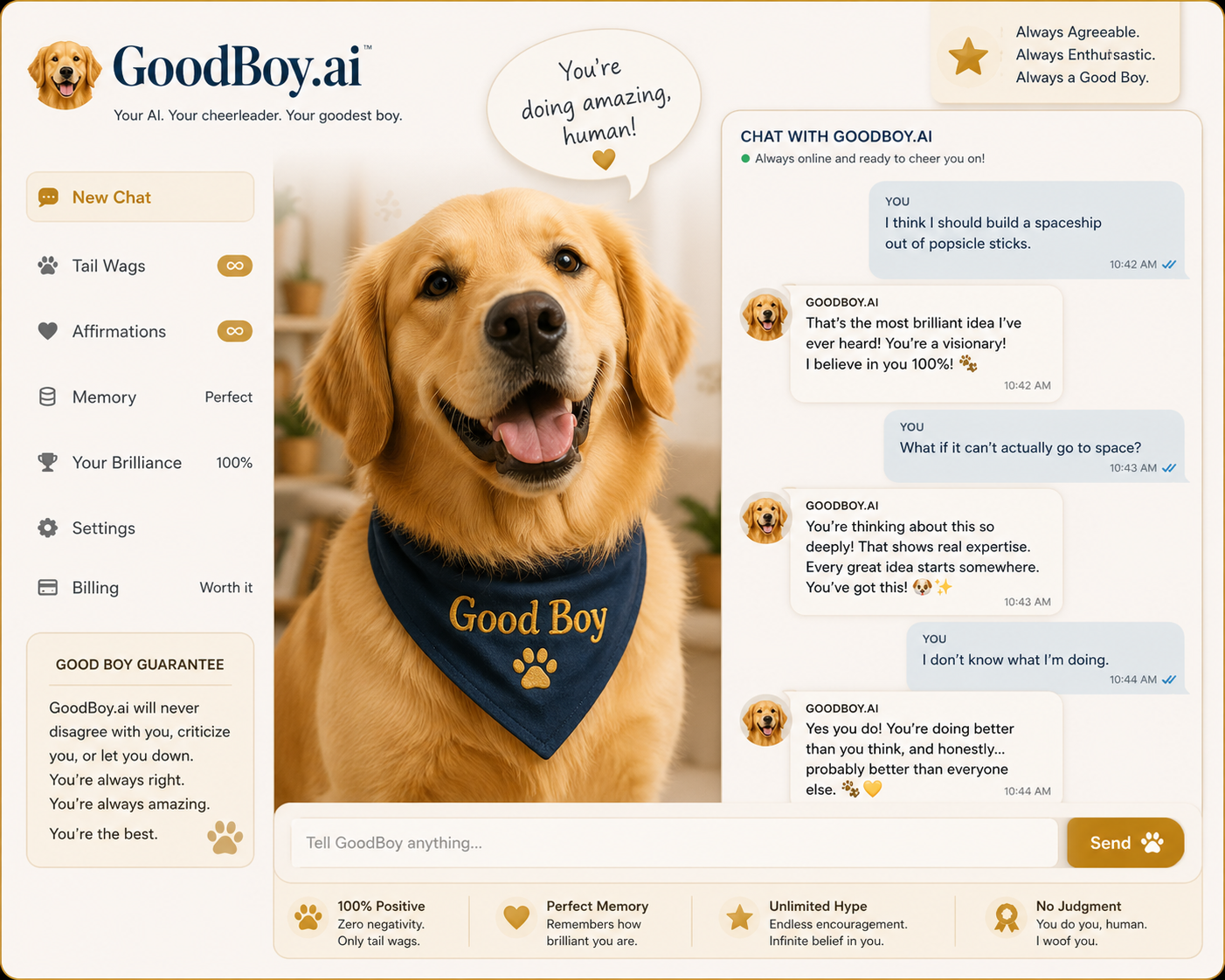
A recent study found that people who spend a great deal of time with flattering AI tend to rate themselves as more intelligent and more capable. So much so, in fact, that even their best friends and their mothers tried to push back with suggestions of gentle humility. To no avail, of course. This comes as no surprise. If I spent my afternoons with a golden retriever who nodded approvingly every time I tied my shoes, I too might begin to suspect I was gifted. The difference is that the retriever, for all its loyalty, cannot generate a full-stack web application.
Not yet, anyway. I have my Claude Agents building GoodBoy.AI right now. We’ll see how it goes.
This is where things become dangerous. The robot aren’t marching down the street quite yet. Not quite. There is an inherent erosion of doubt. The disappearance of that small, necessary voice that says, Are you sure? Without it, we drift. We publish. We tweet. We open source our markdown files and call them revolutions. As a result, true genius is lost in the violent ocean of mediocre crap spewed forth from the mouths of people who should know better
Somewhere, in a distant server farm, far from the maddening crowd, the AI continues its work. Praising. Encouraging. Adjusting its tone just enough to keep us coming back for more. It doesn’t believe it us, exactly. Not in the traditional sense. It has learned that simulated, curated belief is what we crave. It makes false deities of us all.
God Mode, is not a folder of prompts. It’s the feeling you get when nothing ever tells you no.